Hemp bedding for chickens: is it worth the price?
Short answer: hemp bedding for chickens is denser, more absorbent, and much lower in dust than pine shavings — but it costs two to three times as much by volume. It is worth the premium if you or your birds are sensitive to dust, you run a deep-litter coop, or you keep a small flock where one bag lasts a long time. If you are on a tight budget and your current pine setup is working, it is not a must-switch.
I switched my own coop from pine to hemp a couple of seasons ago. The drop in dust when I opened the coop door was the thing I noticed first and the thing that kept me on it — the price is still the part that stings. Below is what hemp bedding actually is, when it is the right call and when it is not, how it stacks up against pine, the brands worth buying, and how to use it.
What is hemp bedding — the 60-second primer
Hemp bedding is the shredded inner core of industrial-hemp stalks, left over after the outer fibre is harvested for textiles and rope. It is naturally absorbent and mildly antimicrobial, and because it is the woody core rather than a sawn-wood by-product, it carries far less fine dust than pine shavings. It is sold by weight — and it feels heavier per cubic foot than pine, because it is denser.
Why use hemp instead of pine shavings, sand, or straw
Four reasons keepers make the switch. Lower dust — better for the respiratory health of both the flock and the person cleaning the coop. Higher absorbency — most manufacturers cite around four times the water uptake of pine by weight, which keeps the coop floor drier. Less frequent change-out — a deep-litter hemp setup runs 8–16 weeks between full cleans instead of 4–6. Faster composting — no wood resins to slow it down, so the spent bedding becomes garden compost in months, not years.
Where hemp is not the right choice
Hemp is not the answer for everyone. On a tight budget, pine shavings cost roughly a third as much and do the job. If you are a deep-litter veteran with a pine system that already works, the switch is optional rather than an upgrade. And in very cold climates, a thick pine layer or a sand floor often manages winter moisture as well as hemp for less money. Be honest about which camp you are in before you buy a bulk bag.
Hemp vs pine shavings, side by side
The head-to-head, factor by factor. We have not run a controlled side-by-side against sand in a desert climate — that comparison belongs in a dedicated bedding guide — but for the hemp-versus-pine question this is the honest summary.
| Factor | Hemp bedding | Pine shavings |
|---|---|---|
| Cost per cubic foot | Higher — 2–3× pine | Lowest-cost option |
| Absorbency | High — soaks up to 4× its weight | Moderate |
| Dust | Low to very low | Moderate to high |
| Composting time | Fast — breaks down readily | Slow — resins delay it |
| Smell control | Strong — locks in ammonia | Fair — needs changing sooner |
| Change-out cycle | Every 8–16 weeks | Every 4–6 weeks |
| Best climate fit | Mild to moderate; deep-litter | Any; cheap to layer thick in cold |
Top hemp bedding picks
Five hemp beddings worth buying, each matched to a situation — from a first trial bag to a bulk deep-litter haul. Volumes and prices were verified against current Amazon listings.
| Product | Best for | Volume | Dust | Price |
|---|---|---|---|---|
| Cranky Frank Hemp Chicken Bedding | Best overall | 115 usable liters | Dust-free, low waste | $64.95 |
| All Walks 150 Liter (30 lb) Hemp Bedding for Chicken Coops | Best value | 150 liters | Dust-free | $49.99 |
| All Walks 18.5 Liter Premium Natural Hemp Bedding | Best small bag | 18.5 liters | Low to no dust | $24.99 |
| Old Dominion Hemp Premium Bedding for Chicken Coops | Best for deep-litter | 285 L (~10 cu ft usable) | Low dust | $58.95 |
| RentACoop Extra-Soft Premium Hemp Bedding | Best premium | 300 L bale (expands to ~10.6 cu ft) | Low dust | $72.95 |
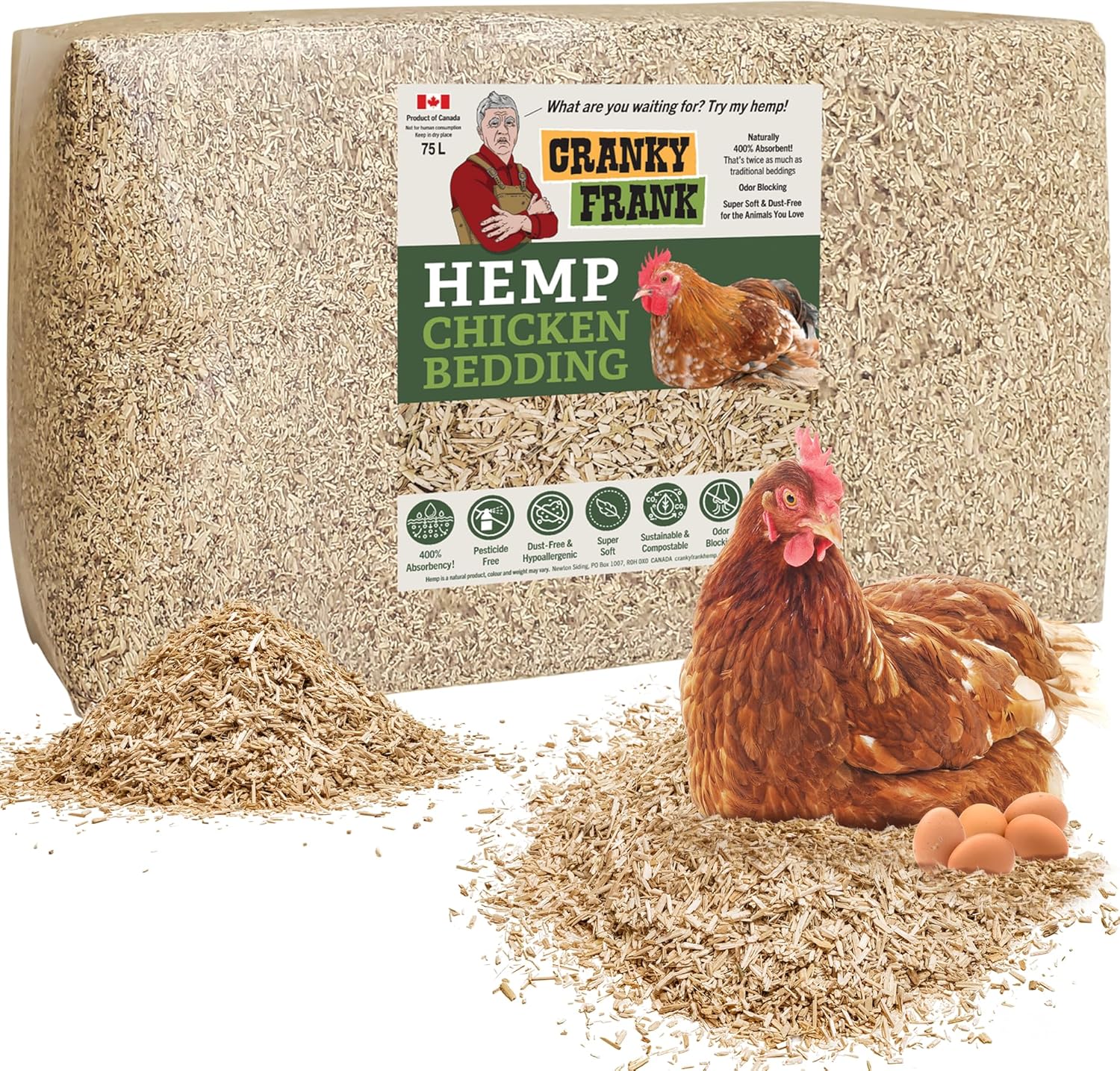
Best overall: Cranky Frank Hemp Chicken Bedding
Best overall
Cranky Frank Hemp Chicken Bedding, 115 Usable Liters / 30 lb
Cranky Frank Hemp
- Volume: 115 usable liters
- Bag weight: 30 lb (28.3 lb item weight)
- Absorbency: Up to 7× its own weight
- Dust: Dust-free, low waste
- Material: 100% industrial hemp
All-natural industrial hemp bedding that absorbs up to seven times its weight and blocks ammonia odour long-term, with a soft, low-dust texture.
Last checked 2026-05-14
The all-round pick. It is 100% industrial hemp, the manufacturer rates it to absorb up to seven times its own weight, and it is genuinely low-dust — the three things you actually want from hemp bedding. The 115 usable-litre bag is enough to lay a fresh coop floor and top up for a while.
Who it is for: most keepers making the switch from pine. What to watch: it is priced like a premium product because it is one — buy it when you have decided hemp is your long-term bedding, not as a casual trial.
Best value: All Walks 150 Liter (30 lb) Hemp Bedding for Chicken Coops

Best value
All Walks 150 Liter (30 lb) Hemp Bedding for Chicken Coops, Made in USA
All Walks
- Volume: 150 liters
- Bag weight: 30 lb
- Package size: 29 × 17 × 12 in
- Dust: Dust-free
- Material: 100% natural hemp, biodegradable, Made in USA
Large bulk bag of biodegradable hemp bedding with strong odour control, sized for chickens, ducks and turkeys.
Last checked 2026-05-14
The value pick. At 150 litres for a lower price than the overall winner, it is the best cost-per-cubic-foot on this list. It is biodegradable, dust-free, made in the USA, and listed for chickens, ducks and turkeys — a straightforward bulk bag with no frills.
Who it is for: anyone bedding a larger coop or buying ahead. What to watch: nothing in particular — this is the practical default if budget is the deciding factor and you still want hemp.
Best small bag: All Walks 18.5 Liter Premium Natural Hemp Bedding

Best small bag
All Walks 18.5 Liter Premium Natural Hemp Bedding, Made in USA
All Walks
- Volume: 18.5 liters
- Use: Poultry and small animals
- Dust: Low to no dust
- Material: 100% tree-free hemp, biodegradable
- Origin: Made in USA
Small trial-size bag of natural hemp bedding, listed for poultry alongside rabbits and other small animals — a low-commitment way to test hemp before buying bulk.
Last checked 2026-05-14
The trial-size pick. At 18.5 litres it is a low-commitment way to find out whether hemp suits your coop and your routine before you spend on a bulk bag. It is the same tree-free, low-dust hemp as the larger bags, just in a quantity you can carry one-handed.
Who it is for: first-time hemp buyers, and chick brooders. What to watch: the cost per litre is high at this size — that is the price of trying before you commit, and it is a fair trade.
Best for deep-litter: Old Dominion Hemp Premium Bedding for Chicken Coops

Best for deep-litter
Old Dominion Hemp Premium Bedding for Chicken Coops, 285L (~10 cu ft) / 30 lb
Dominion Hemp
- Volume: 285 L (~10 cu ft usable)
- Bag weight: 30 lb
- Absorbency: Up to 4× its weight
- Dust: Low dust
- Material: USA-grown hemp stalks
High-volume hemp bedding from USA-grown hemp stalks — enough usable volume to build and top up a deep-litter coop floor.
Last checked 2026-05-14
The deep-litter pick. At roughly 285 litres — about 10 cubic feet of usable volume — this is the bag for building and maintaining a deep-litter coop floor without reordering constantly. It is made from USA-grown hemp stalks and rated to absorb around four times its weight.
Who it is for: keepers running the deep-litter method who want one big delivery instead of several small ones. What to watch: it is a large, heavy bag — have a dry place to store what you do not use immediately.
Best premium: RentACoop Extra-Soft Premium Hemp Bedding

Best premium
RentACoop Extra-Soft Premium Hemp Bedding, 300L Bale
RentACoop
- Volume: 300 L bale (expands to ~10.6 cu ft)
- Coverage: ≈60 sq ft at 2-inch depth
- Absorbency: 5× more than pine shavings
- Dust: Low dust
- Fiber: Extra-soft rounded fibers
Compressed 300-litre bale of pure hemp with soft, rounded fibres that are gentle on feet and feathers, plus strong moisture and ammonia control.
Last checked 2026-05-14
The premium pick. A compressed 300-litre bale that expands to roughly 10.6 cubic feet, with extra-soft rounded fibres that are gentler on feet and feathers than coarser hemp. The manufacturer rates it at five times the absorbency of pine shavings.
Who it is for: keepers who want the cleanest, softest option and will pay for it — and anyone with a flock prone to bumblefoot who wants a forgiving floor. What to watch: it is the most expensive pick here, so buy it for the comfort upgrade, not the volume.
How much hemp bedding do you need
Start with a 4–6 inch layer on the coop floor. For a roughly 4×8 ft coop that works out to about 25–30 lb of hemp for the initial layer. After that you top up every two to four weeks as the birds work it in, and do a full change-out every 8–16 weeks depending on flock size and ventilation — compared with every 4–6 weeks for pine. One bulk bag covers the initial layer for most backyard coops with bedding to spare.
How to use it — the deep-litter walkthrough
Lay the initial 4–6 inch layer over a clean, dry coop floor. As droppings accumulate, add a thin top-up layer every couple of weeks rather than waiting and dumping a lot at once — little and often keeps the surface dry. Stir the litter occasionally, or let the birds do it for you by tossing a handful of scratch on top so they turn it themselves; turning keeps it aerobic and stops it from packing down and smelling. When the layer finally needs to go, the spent hemp-and-droppings mix is excellent compost — pull it for the garden rather than throwing it out.
Frequently asked questions
Is hemp bedding safe for chickens?
Yes. Hemp bedding is made from shredded industrial-hemp stalks, is naturally low in dust, and contains no oils or aromatic compounds that irritate poultry airways. It is widely used for laying hens, chicks and other backyard poultry with no known safety issues.
How does hemp compare to pine shavings for backyard chickens?
Hemp is more absorbent, far lower in dust, controls ammonia smell better, and composts faster — but it costs two to three times as much as pine shavings by volume. Pine wins purely on price. The comparison table above breaks it down factor by factor.
How long does hemp bedding last in a chicken coop?
In a deep-litter setup, hemp bedding typically goes 8–16 weeks between full change-outs, compared with 4–6 weeks for pine. You top it up every two to four weeks. Higher absorbency and slower breakdown are what stretch the cycle.
Where can I buy hemp bedding for chickens?
Hemp bedding is sold online through Amazon and direct from hemp-farm brands, and increasingly in farm-supply stores. Buying by the bulk bag online is usually the lowest cost per cubic foot. The picks above are current US-shipping options.
Can hemp bedding be composted?
Yes, and it composts faster than pine. Hemp has no resins to slow breakdown, so used hemp bedding plus chicken droppings becomes garden compost in a few months. It is one of the practical advantages hemp has over wood-based bedding.
Does hemp bedding control coop smell?
It controls smell well. Hemp absorbs up to four times its weight in moisture and locks in ammonia, which is the source of most coop odour. A dry, well-ventilated coop on hemp bedding stays noticeably fresher between cleans than one on pine.
Is hemp bedding good for chicks?
Yes — its low dust is an advantage in an enclosed brooder, and the soft texture is gentle on chick feet. Use a shallow layer at first so chicks can find feed easily, and make sure they are eating starter feed and not the bedding.
How much hemp bedding do I need for 6 chickens?
For a roughly 4×8 ft coop housing six hens, a 25–30 lb starting layer at 4–6 inches deep is about right. After that, top up every two to four weeks. One large bulk bag covers the initial layer with some to spare.